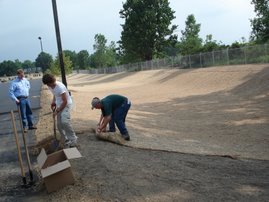
On October 21, 2008, a dozen of us toured the newly finished Carrier Creek detention areas and its rehydrated wetland.
Thanks to David Wilcox (Chief of Engineering, Eaton County Drain Commissioner) and Paul Forton (Engineer, Spicer Engineering) for the wonderful tour. We all walked away knowing more than when we got there. I have seen the project many times, but I think this tour of the final product was the best.
Showing posts with label SESC. Show all posts
Showing posts with label SESC. Show all posts
Monday, October 27, 2008
Wednesday, April 16, 2008
Great Article on Working Togethor for Solutions
Occasionally things go wrong. Here is an article on how one community dealt with a severe soil erosion mishap.
Pulling Together for Erosion Control
I think we have many lessons to learn from this article.
Pulling Together for Erosion Control
I think we have many lessons to learn from this article.


Thursday, April 3, 2008
Meeting: Tuesday May 8th
Hey its about time for me to tell you about our next Soil Erosion Group meeting.
It will be in Grand Ledge at ET MacKenzie's barn again.
May 8th, 2008 (Thursday)
12:00 (NOON) to 3:00PM
3173 Jefferson St. Grand Ledge, MI 48837
Questions: Charlie's cell# 517-749-4443 (for directions)
Speaker:
Mike De Boer, Superior Groundcover, Inc.
Filtrexx representative and installer.
Filtrexx is a versatile product that can be useful in many situations. It is a tube filled with blown in mulch. It has tremendous potential to remove particulate matter. You will be surprised to see what this can do.
Please RSVP as soon as possible so I can know how many will be there for lunch.
It will be in Grand Ledge at ET MacKenzie's barn again.
May 8th, 2008 (Thursday)
12:00 (NOON) to 3:00PM
3173 Jefferson St. Grand Ledge, MI 48837
Questions: Charlie's cell# 517-749-4443 (for directions)
Speaker:
Mike De Boer, Superior Groundcover, Inc.
Filtrexx representative and installer.
Filtrexx is a versatile product that can be useful in many situations. It is a tube filled with blown in mulch. It has tremendous potential to remove particulate matter. You will be surprised to see what this can do.
Please RSVP as soon as possible so I can know how many will be there for lunch.
Thursday, February 7, 2008
February 5, 2008 Meeting Min
QUARTERLY MEETING, February 5, 2008
About 60 people in attendance
Lunch: Complements of E.T. MacKenzie Companies
Old Business:
CPESC training and testing and recognition of newly certified professionals,
Congradulations to the following people who successfully completed the certification requirements for C.P.E.S.C.
Last Summers Field Day for Rolled Erosion Control
Wednesday, June 27, our group organized our first field demonstration day. We had 35 people from 15 different organizations in attendance. Spartan Motors was very cooperative and allowed us to utilize their site to demonstrate proper installation methods for a few temporary stabilization methods.
(Slides of the site were viewed while we ate)
New Business:
Future Continuing Education Opportunities
Nobody had any ideas, if you come up with some make sure to let Kevin Kalmbach know.
Discussion of forming a Non-Profit Organization
Contact Kevin Kalmbach if you wish to help organize the group into a Non-Profit entity.
Topics for next meeting(s) - Suggestions
Interest was expressed for better Construction Entrances and controling tracking and traffic problems.
Speaker: Steve Irwinski, APS - Silt Stop http://www.siltstop.com/
In addition to his company link above, Steve suggested going to http://www.stormwater.ucf.edu/ to get some very up to date and valuable information. One of the items found there is the State of Florida Erosion & Sediment Control Designer & Reviewer Manual a very good manual even for us here in Michigan.
Steve demonstrated how PAM's work and stressed the need for the designer to get the EPA Certified Toxicity Reports for the chemical before using or specifying it. This is not the MSDS sheets! Make sure to ask questions.
Specify the product by name, dont just specify PAM's, who knows what the contractor will get. Do the research, read the Certified Toxicity Reports and specify the exact product to use. Unfortunately, this isn't one of thoes thing we can just keep a bag of in the truck incase we need to use it. Soil testing is imperitave (and getting the EPA Cerified Toxicity Reports).
He also demonstrated what happens if you do not test the soil before choosing the correct polymer. Collecting a soil sample is easy, and testing is quick. The testing basicaly determines which polymers work and which do not work for that particular soil.
About 60 people in attendance
Lunch: Complements of E.T. MacKenzie Companies
Old Business:
CPESC training and testing and recognition of newly certified professionals,
Congradulations to the following people who successfully completed the certification requirements for C.P.E.S.C.
Last Summers Field Day for Rolled Erosion Control
Wednesday, June 27, our group organized our first field demonstration day. We had 35 people from 15 different organizations in attendance. Spartan Motors was very cooperative and allowed us to utilize their site to demonstrate proper installation methods for a few temporary stabilization methods.
(Slides of the site were viewed while we ate)
New Business:
Future Continuing Education Opportunities
Nobody had any ideas, if you come up with some make sure to let Kevin Kalmbach know.
Discussion of forming a Non-Profit Organization
Contact Kevin Kalmbach if you wish to help organize the group into a Non-Profit entity.
Topics for next meeting(s) - Suggestions
Interest was expressed for better Construction Entrances and controling tracking and traffic problems.
Speaker: Steve Irwinski, APS - Silt Stop http://www.siltstop.com/
In addition to his company link above, Steve suggested going to http://www.stormwater.ucf.edu/ to get some very up to date and valuable information. One of the items found there is the State of Florida Erosion & Sediment Control Designer & Reviewer Manual a very good manual even for us here in Michigan.
Steve demonstrated how PAM's work and stressed the need for the designer to get the EPA Certified Toxicity Reports for the chemical before using or specifying it. This is not the MSDS sheets! Make sure to ask questions.
Specify the product by name, dont just specify PAM's, who knows what the contractor will get. Do the research, read the Certified Toxicity Reports and specify the exact product to use. Unfortunately, this isn't one of thoes thing we can just keep a bag of in the truck incase we need to use it. Soil testing is imperitave (and getting the EPA Cerified Toxicity Reports).
He also demonstrated what happens if you do not test the soil before choosing the correct polymer. Collecting a soil sample is easy, and testing is quick. The testing basicaly determines which polymers work and which do not work for that particular soil.
Wednesday, February 7, 2007
Soil Erosion Plans
My goal is always to be in a position to enable builders and developers to responsibly develop their land. Since our forefathers failed to care about the environment and just looked at the land as a commodity, we now must pay the price of government regulation.
So far its not that bad. The developer (or their engineer) chooses how the development progresses and determines the products used. There is only about 13 things listed in Part 91 that must be on the plan. The real design is up the engineer.
As an Engineer, I realize the need to utilize standard drawings and cookie cutter plans. But that doesn't cut it for soil erosion. At the least, you must consider the soil type and slope.
The plan should show pre-existing conditions, final conditions and detailed instructions on how to go from one to the other. Typical items missing from plans I see are products used and construction details. How do you bid a project if you don't know which Geotextile fabric they want? How about all thoes plans I see with silt fence details showing wire backing?
Heres my suggestion. First, design the site. Its probably already layed out when you get it. Design the roads and balance the dirt. Do all the standard CE work.
Second, go through the list of things in Part 91 and put them on the plan. This includes soil descriptions. Are they erodible? Which way does the land slope? Where is the nearest water? Where are the existing catchbasins?
Third, think about the site. Protect everything identified in the above step. Silt fence does not stop erosion and therefore does not protect the land. If you don't know how to stop erosion, either learn or hire an individual who does. I am sorry if I sound harsh, but if you cant do it learn how. Plan review takes much longer if the enforcing agent needs to train the designer in the process.
Fourth, instruct your draftsman (or do it yourself) to place standard details for ALL the items listed in your "keying system". Then, you must update them to reflect specific item selections. You are the engineer, use your knowledge to make educated decisions.
If you follow this process you will be able to intelegently argue the basis of design for your project instead of arguing about the "requirements" for part 91.
Finaly, visit the site while it is being built to see what your plan was lacking. We can always do better.
So far its not that bad. The developer (or their engineer) chooses how the development progresses and determines the products used. There is only about 13 things listed in Part 91 that must be on the plan. The real design is up the engineer.
As an Engineer, I realize the need to utilize standard drawings and cookie cutter plans. But that doesn't cut it for soil erosion. At the least, you must consider the soil type and slope.
The plan should show pre-existing conditions, final conditions and detailed instructions on how to go from one to the other. Typical items missing from plans I see are products used and construction details. How do you bid a project if you don't know which Geotextile fabric they want? How about all thoes plans I see with silt fence details showing wire backing?
Heres my suggestion. First, design the site. Its probably already layed out when you get it. Design the roads and balance the dirt. Do all the standard CE work.
Second, go through the list of things in Part 91 and put them on the plan. This includes soil descriptions. Are they erodible? Which way does the land slope? Where is the nearest water? Where are the existing catchbasins?
Third, think about the site. Protect everything identified in the above step. Silt fence does not stop erosion and therefore does not protect the land. If you don't know how to stop erosion, either learn or hire an individual who does. I am sorry if I sound harsh, but if you cant do it learn how. Plan review takes much longer if the enforcing agent needs to train the designer in the process.
Fourth, instruct your draftsman (or do it yourself) to place standard details for ALL the items listed in your "keying system". Then, you must update them to reflect specific item selections. You are the engineer, use your knowledge to make educated decisions.
If you follow this process you will be able to intelegently argue the basis of design for your project instead of arguing about the "requirements" for part 91.
Finaly, visit the site while it is being built to see what your plan was lacking. We can always do better.
Thursday, January 18, 2007
Conquest of the Land through 7000 years
A wonderful personal report by Dr. Walter Clay Lowdermilk detailing historical soil erosion over the history of the world has been re-published by the USDA. See this link
http://www.nrcs.usda.gov/technical/ecs/agecol/conquest.html
He covers soil erosion from the beginnings of post-flood civilization in Mesopotamia to current (1930's) catastrophes such as the Dust Bowl . He ends the paper with the "Eleventh Commandment"
Thou shalt inherit the Holy Earth as a faithful steward, conserving its resources and productivity from generation to generation. Thou shalt safeguard thy fields from soil erosion, thy living waters from drying up, thy forests from desolation, and protect thy hills from overgrazing by thy herds, that thy descendants may have abundance forever. If any shall fail in this stewardship of the land thy fruitful fields shall become sterile stony ground and wasting gullies, and thy descendants shall decrease and live in poverty or perish from off the face of the earth.
http://www.nrcs.usda.gov/technical/ecs/agecol/conquest.html
He covers soil erosion from the beginnings of post-flood civilization in Mesopotamia to current (1930's) catastrophes such as the Dust Bowl . He ends the paper with the "Eleventh Commandment"
Thou shalt inherit the Holy Earth as a faithful steward, conserving its resources and productivity from generation to generation. Thou shalt safeguard thy fields from soil erosion, thy living waters from drying up, thy forests from desolation, and protect thy hills from overgrazing by thy herds, that thy descendants may have abundance forever. If any shall fail in this stewardship of the land thy fruitful fields shall become sterile stony ground and wasting gullies, and thy descendants shall decrease and live in poverty or perish from off the face of the earth.
Subscribe to:
Posts (Atom)